
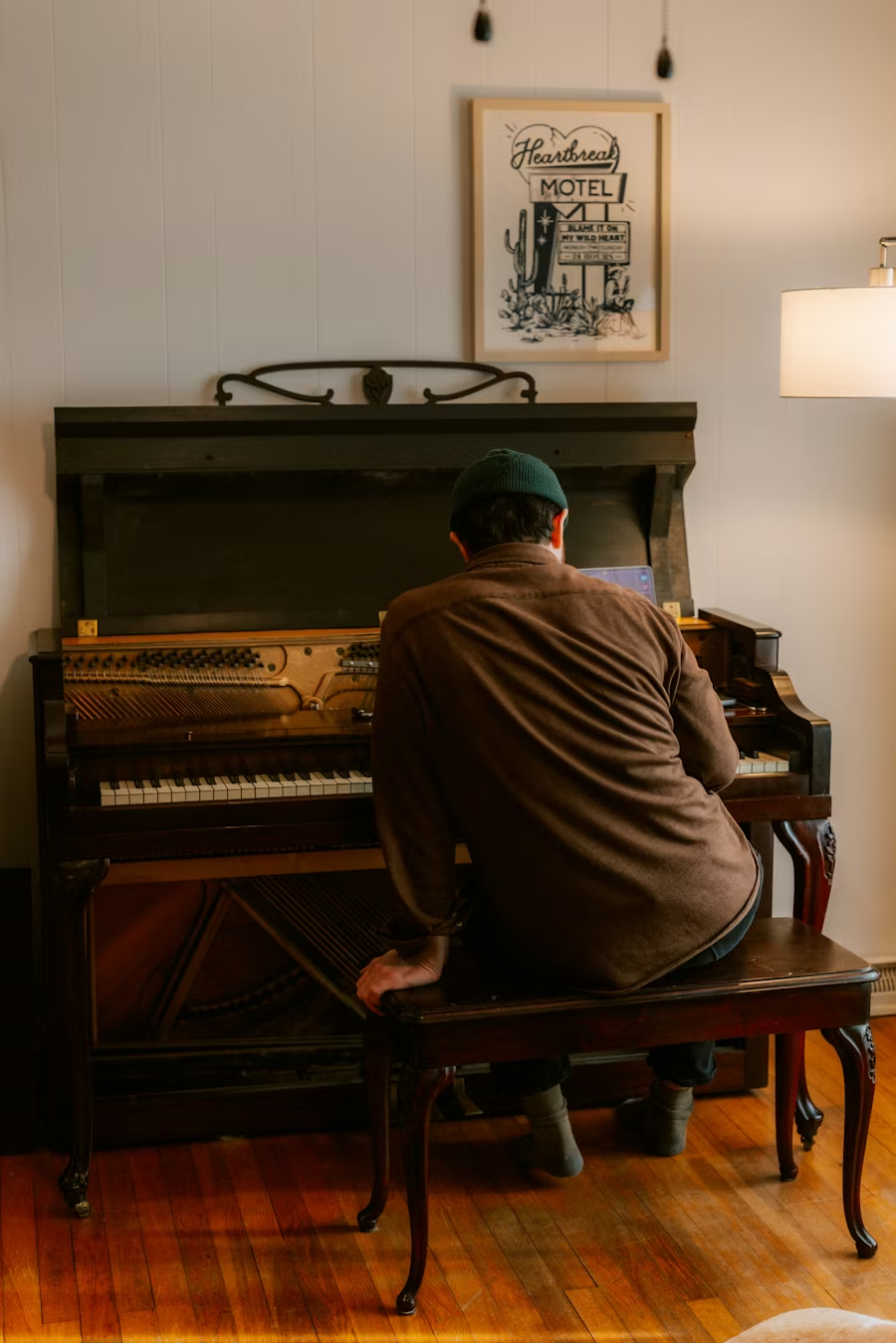
A year ago, my uncle Greg asked me something that sounded simple, but I could tell it had been sitting heavily in his mind:
“Am I too old to learn piano?”
He was 52.
He just wanted to know if he had already missed his chance to learn something he had always wanted to do.
Now, one year later, he can play simple pieces, read basic sheet music, and actually enjoys sitting down at the piano. That last part matters more than people think. He is not forcing himself through some noble self-improvement project. He genuinely likes playing.
So if you are asking yourself whether you can learn piano as an adult, I want to say this as clearly as possible: yes, you absolutely can.
The Biggest Barrier Is Usually Mental
What I noticed with my uncle was that his main problem was not his hands, his age, or his ability. It was the story he was telling himself before he even began.
Adults tend to come into piano with a lot of mental baggage. We compare ourselves to kids. We assume we will be slower. We feel embarrassed about being beginners. We expect every mistake to mean something dramatic, as if one clumsy left-hand passage proves the universe was right all along.
Kids usually do not think this way. They just try things. Adults, on the other hand, can spend half their energy worrying that they are “too late.”
Honestly, I think this is the biggest barrier for many adult beginners. Not age itself, but the belief that age has already decided the outcome.
Yes, Adults Have Real Constraints, but They Are Not Dealbreakers
To be fair, learning piano as an adult is not identical to learning as a child.
Adults usually have less free time, more stress, and more responsibility. Practice has to compete with work, family, errands, tiredness…
There are also some physical differences. Research on aging and hand function shows that, over time, finger strength, steadiness, and dexterity can decline, and finger movements may become a little less independent. So yes, younger learners may have some advantages, especially if they start very early and spend years building coordination.
But this is where people jump to the wrong conclusion.
Saying that children may develop certain physical skills earlier is not the same thing as saying adults cannot learn piano well. It just means adults may need a bit more patience, better pacing, and a sensible technique-first approach instead of trying to play difficult music too soon.
Greg definitely felt some stiffness at the beginning. His fingers were not exactly floating like elegant ballet dancers across the keys. But with regular practice, that changed. Not magically, and not overnight, but clearly.
The Science Is More Encouraging Than the Myth
This is the part I find really hopeful.
There is actual research showing that older adults can still learn through piano training and improve in meaningful ways.
One study found that older adults improved fine motor control after a year of piano lessons. Another found measurable brain changes after six months of piano learning in older adults. A randomized controlled trial also found that piano training improved things like working memory, verbal fluency, and musical self-efficacy in aging adults.
That does not mean every adult beginner will suddenly become a virtuoso, but it does mean the adult brain is still capable of adapting, learning, and building skill. The idea that you are simply “too old” to learn an instrument is not supported by the evidence.
What Helped My Uncle Most
The turning point for Greg was not some heroic burst of discipline. It was finding a way to learn that felt less frustrating.
Sheet music was the hardest part for him at first. He wanted to learn it properly, but he also did not want every practice session to feel like decoding a secret message.
That is where SunScore helped him. He started using it to practice from real music while also seeing the piece more visually, and that made the whole process much easier to understand. It helped him connect the notes on the page to the keyboard faster, and it made practice feel less heavy and discouraging.
I think that mattered a lot. He was not choosing between “real reading” and “just copying shapes.” He had a bridge between the two, which made learning sheet music feel much more natural.
Adults Actually Have Some Advantages Too
This part gets overlooked all the time.
Adults may not learn in the same way children do, but they often bring strengths that kids do not have:
- they usually understand goals more clearly
- they can be more intentional about practice
- they often notice patterns faster
- they chose piano for themselves, which is a powerful kind of motivation
Greg was a great example of this. Once he got past the fear, he was very steady. He did not need to be pushed into practice. He wanted to understand what he was doing. He asked good questions. He paid attention to small improvements. That kind of mindset goes a long way.
So, Am I Too Old to Learn Piano?
If you are an adult asking that question, I really think the answer is no.
Maybe you will not progress exactly like a child who started at six.
Maybe your fingers will need more time to loosen up.
Maybe your schedule will be chaotic and annoying because adulthood has no respect for hobbies.
But none of that means it is too late.
If anything, the more useful question is this: are you willing to be a beginner for a while?
Because that is the real price of learning piano as an adult. Not your age. Not your tendons. Not some imaginary deadline. Just the willingness to start imperfectly and keep going.
Greg did that at 52.
At 53, he was playing simple music, reading sheet music better than he ever thought he would, and enjoying the instrument he once thought might be “too late” for him.
Sources
Fine motor control improves in older adults after 1 year of piano lessons, Piano training enhances executive functions and psychosocial outcomes in aging, Effects of aging on hand function, Single finger movements in the aging hand, Piano training-induced cortical plasticity and cognitive changes in older adults.