
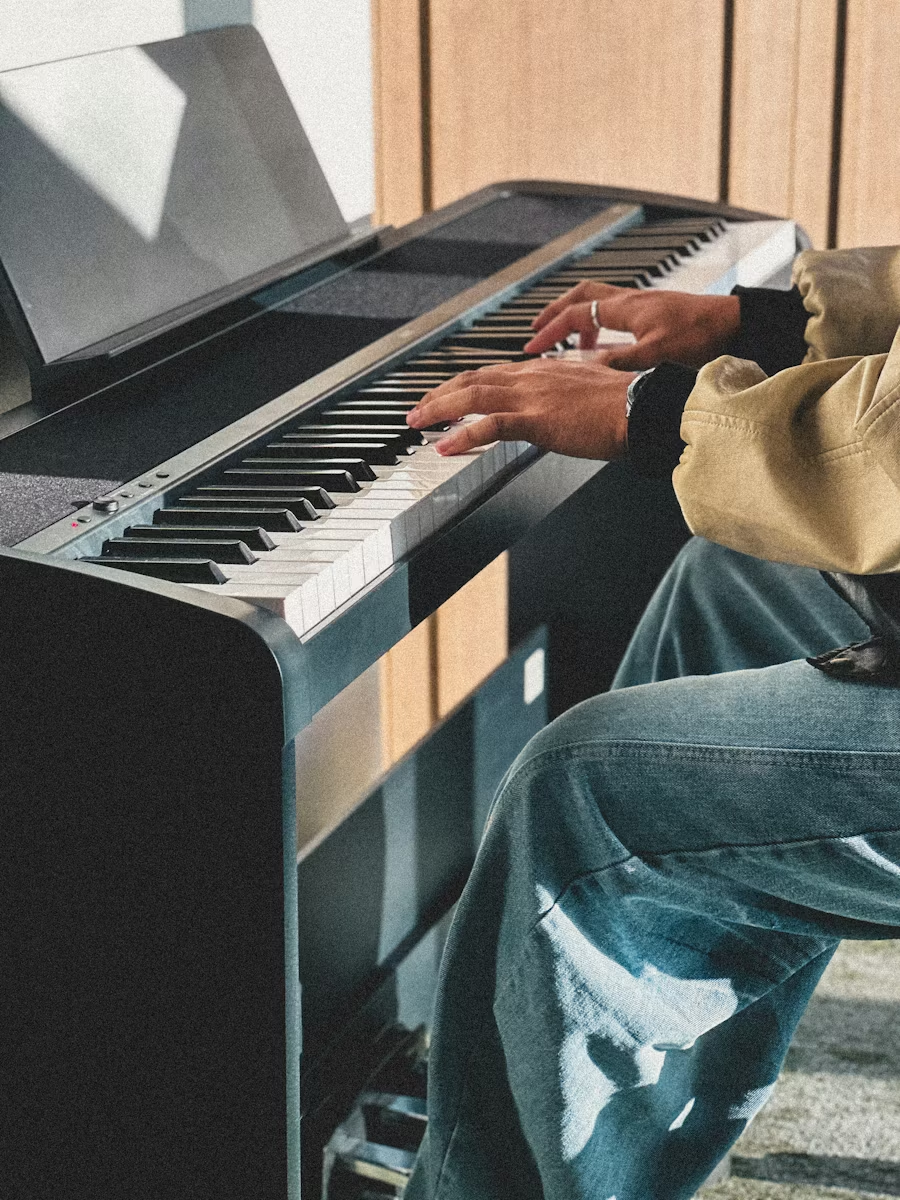
If you had told me when I started piano that so much of my progress would depend on tiny movements in my ring finger, I probably would have smiled politely and then gone right back to wondering why a simple five-finger pattern felt like such a struggle.
Finger dexterity sounds like a big technical phrase, but it just comes down to this: can my fingers do what I want them to do without stiffening up, lagging behind, or turning one simple passage into a small disaster?
That was the problem I kept running into. I wanted smoother playing, better control, and less of that weird feeling where my weaker fingers seemed to be improvising their own version of the piece. So I looked into the main ways pianists actually improve finger dexterity, and a few techniques kept coming up again and again.
Start with slow, controlled practice
This is the least glamorous advice and probably the most useful.
When I try to practice too fast, I usually end up repeating bad movement patterns. My fingers might survive the passage, but they are not really learning it well. Slower practice gives each finger time to land correctly, stay relaxed, and build control.
It also makes it much easier to hear whether the notes are even. Unevenness is one of the biggest signs that finger control still needs work, and it is much easier to notice at a manageable tempo than in full panic mode.
Relaxation matters more than you expect
I used to think dexterity meant stronger fingers and more effort. What I eventually realized is that tension is often the bigger enemy.
If my hand, wrist, or forearm is tight, my fingers stop feeling agile very quickly. Everything gets heavier. Fast passages feel harder. Repeated notes feel clumsy. Even simple patterns start to feel annoying.
What helps me most is checking for a few basics:
- relaxed shoulders
- a loose wrist
- naturally curved fingers
- no pressing harder than necessary
This part sounds simple, but it makes a huge difference. Dexterity is not just about movement. It is also about removing the tension that blocks movement.
Practice scales and arpeggios
Scales and arpeggios are classic for a reason. They train coordination, fingering, evenness, and the ability to move around the keyboard efficiently.
I do not always wake up excited to practice them, because that would be a dramatic overstatement, but they help. Scales are especially good for building smooth finger transitions and steady rhythm. Arpeggios help the hand learn larger shapes without everything feeling awkward and jumpy.
They are also useful because they show up everywhere in actual music. So even when they feel repetitive, they are not random.
Work on finger independence
Some fingers are just less cooperative than others. Fourth and fifth fingers have made that very clear.
Finger independence exercises help train each finger to move more clearly on its own instead of dragging the whole hand into the motion. That can improve control, balance, and consistency, especially in passages where one finger has to stay active while the others remain steady.
This is one reason technical exercises still matter. Pieces teach musicality, but exercises can isolate specific mechanical problems in a way that real repertoire sometimes does not.
Hanon, Hanon, Hanon
Out of all the common dexterity techniques, Hanon is the one I keep returning to most.
Hanon exercises are simple, repetitive patterns designed to improve finger control, coordination, and evenness. They are not exactly thrilling entertainment. No one has ever said, “Please play that Hanon exercise again, it moved me deeply.” But they are useful in a very honest, practical way.
What I like about Hanon is that it removes a lot of noise. When I practice a piece, I am thinking about rhythm, notes, phrasing, fingering, articulation, and whatever emotional issue a single accidental has created for me that day. Hanon strips things down. It lets me focus on whether my fingers are moving evenly, whether my hand is staying relaxed, and whether I actually have control.
I like practicing Hanon in SunScore. It makes Hanon exercises straightforward to follow, so I can spend more energy paying attention to evenness, control, and relaxation.
For me, the key is practicing Hanon the right way:
- start slowly
- keep the hand relaxed
- listen for even tone
- use consistent fingering
- increase speed only when it still feels easy and controlled
The moment it turns into a speed contest, I stop getting much out of it. If I tense up just to play faster, then I am training tension too, which is not exactly the goal.
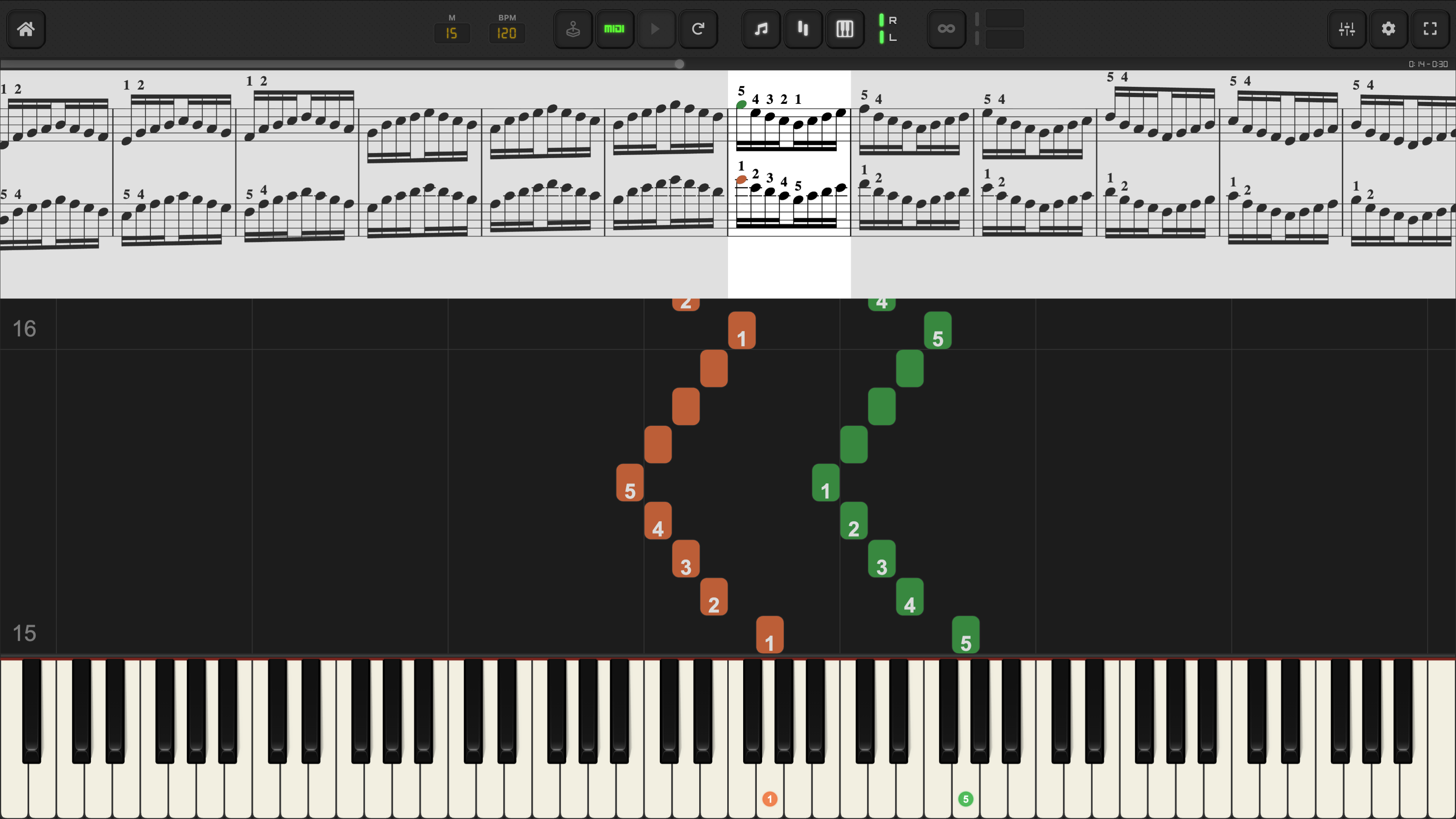
A Hanon exercise on the SunScore app. Learning the exercise and fingering is straightforward.
Hanon works best as part of a bigger routine
The routine that helps me most is pretty simple:
- a few minutes of Hanon for finger control
- scales or arpeggios for coordination
- actual pieces to apply that technique musically
That combination feels balanced. Hanon gives me focused technical work, and real music gives that work a purpose.
For me, finger dexterity did not improve through one magical breakthrough. It got better through short, regular practice sessions where I stayed relaxed, slowed things down, and repeated good movements instead of messy ones. Hanon has been one of the most helpful tools in that process.
So if your fingers feel stiff, uneven, or just slightly rebellious, I would start there. Slow practice. Relaxation. Scales. Arpeggios. Hanon.