
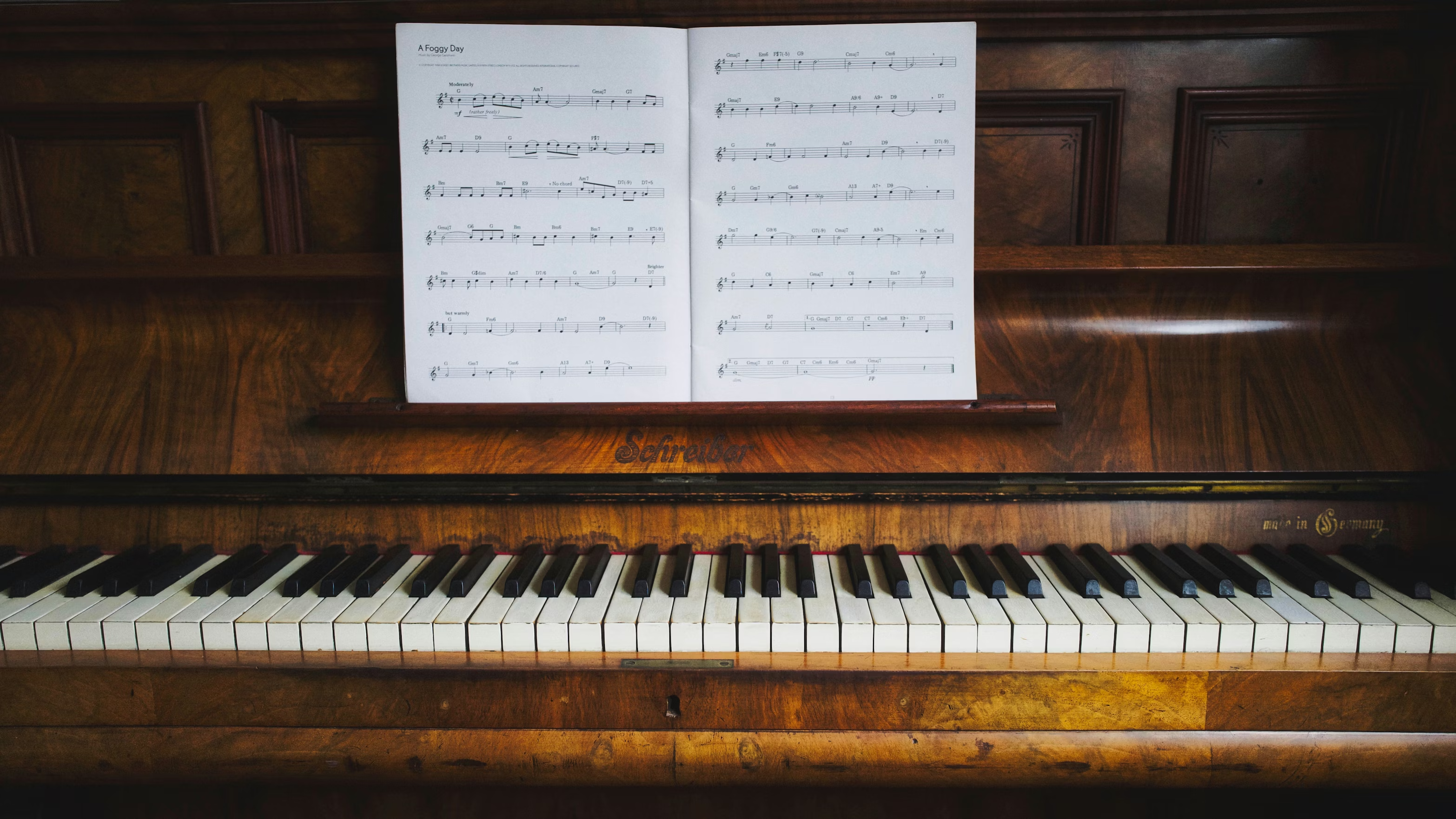
When I first wanted to learn piano, I did not dream about becoming really good at decoding tiny black dots on five little lines. I wanted to play.
That was the problem.
Pretty quickly, I realized that if you start piano the traditional way and you cannot read music yet, a lot of your practice time turns into slow-motion detective work. You stare at the score, guess the note, find the key, lose your place, sigh dramatically, and repeat. Very musical.
And the frustrating part is that this is not just a “bad first week” problem. Learning to read sheet music well can take years. Not learning the basics, those can start fairly quickly, but reading comfortably enough that it feels natural? That usually takes a long time.
So if you are sitting there thinking, “I want to play piano, but I really do not want my whole life to become a sheet music decoding project,” I get it.
The good news is that you do have options.
Option 1: Learn only through piano roll videos
This is usually the first escape route.
You open YouTube, find a tutorial with falling bars, and suddenly piano feels possible again. You do not need to read notation. You just copy what you see and press the keys when the bars hit the keyboard.
Honestly, I understand why people love this. It is fast, visual, and much less intimidating than opening a full score for the first time.
But there is a catch.
Piano rolls are great if your goal is to memorize one song. They are much less great if your goal is to actually become a pianist.
Why? Because they teach you the shortcut, not the language. You can copy notes, but you are not really learning how music is written. So every new song sends you back to the same place: searching for another tutorial and starting from zero again.
That is why I think piano rolls are useful, but limited. They help you play a song. They do not really help you grow independent.
Option 2: Force yourself through sheet music from day one
This is the traditional answer, and to be fair, it does work.
If you stay consistent, you will improve your reading over time. The problem is that for a lot of beginners, this route is painfully slow in the beginning. You spend so much energy trying to understand the page that you barely get to enjoy the instrument.
That is the part people do not always say clearly enough.
The issue is not that sheet music is bad. The issue is that if reading is your weakest skill, it can dominate everything else. Instead of feeling like you are learning piano, it can feel like you are wrestling with notation while the piano waits in the corner.
Option 3: Put piano first, and let reading follow
This is the approach that really makes.
I think the ideal way to learn is not to put sheet music reading first and piano second. It should be the other way around. First, you play the instrument. First, you enjoy the instrument. First, you build confidence, coordination, and a real connection with the keyboard.
Then, as a consequence of that process, you start learning how to read.
That does not mean avoiding sheet music forever. It means not making reading the gatekeeper that decides whether you are allowed to enjoy piano yet.
How to put piano first: the SunScore approach
SunScore lets you start by playing, not by decoding. You can upload a score and practice it with visual help like the piano roll, keyboard guidance, looping, and hand isolation, while the real sheet music stays visible.
So the piano comes first. You get to enjoy the instrument, learn the piece, and build confidence at the keyboard. Then, little by little, reading starts to improve as a consequence of playing.
If you can’t read music, what should you do?
If your goal is to enjoy piano, I would not wait until you can read fluently before letting yourself play.
Play first. Build the habit. Learn songs you care about. Get comfortable at the keyboard. Then let reading improve alongside that process instead of making it the gatekeeper for everything.