
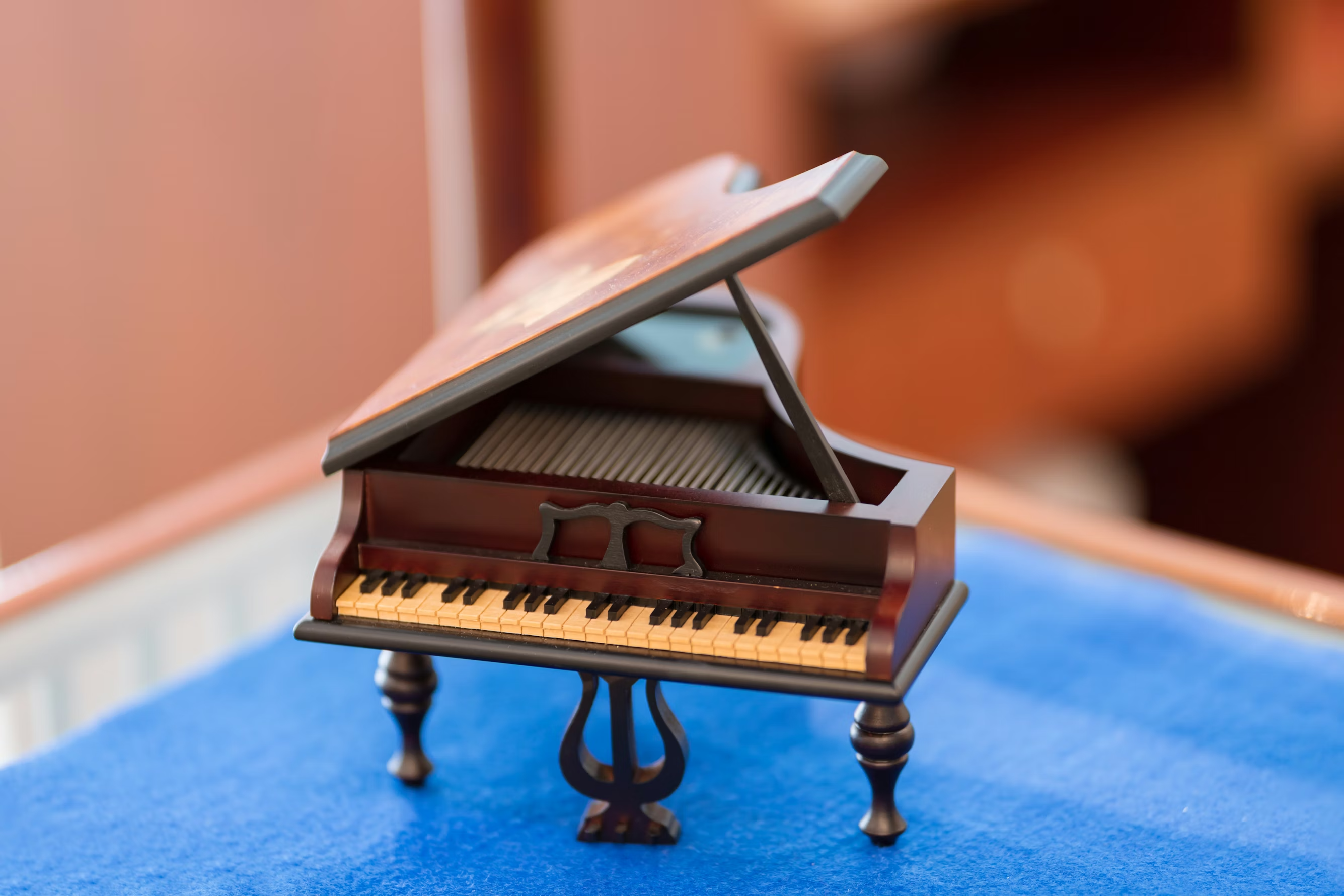
When you start learning piano, scales can feel like the homework you are supposed to respect but do not exactly want to invite into your afternoon. If all you want to do is play songs, scales can seem like the thing standing between you and the fun part.
Unfortunately for my lazy side, learning scales really is important. But not because you need to become a scale robot. It matters because scales make actual music easier to play, easier to understand, and a lot less intimidating.
Why scales matter so much
One of the biggest benefits is that scales build technique in a very direct way. They train finger control, coordination, hand position, and evenness. When you practise them regularly, your hands feel less awkward on the keyboard, and passages in pieces stop feeling completely random.
They also improve keyboard geography. That sounds technical, but really it just means you start to know where you are. Different keys stop feeling like hostile territory. Your fingers get used to common patterns, and you spend less time wondering why one passage suddenly feels like a trap.
Scales also help with music theory in a way that feels much more practical than reading theory explanations on a page. Key signatures, intervals, chords, and harmonic patterns all make more sense when you actually know the scale behind them.
Another benefit is sight-reading. Piano pedagogy sources regularly connect scale practice with better familiarity with keys, pitch awareness, and more confidence when learning new pieces. Music looks less chaotic when the key and note patterns already feel familiar under your hands.
Scales are also good for listening. If you play them carefully, you can hear uneven tone, rushing, tension, or a weaker finger trying to hide in the background. In that sense, scales are not just finger exercises. They are attention exercises too.
And then there is the simple fact that real music is full of scale-based patterns. Runs, melodies, accompaniment figures, and transitions often come from scale motion or something close to it. So even if scales can feel repetitive on their own, they show up everywhere once you go back to real pieces.
What scales actually help with
If I had to summarize the main benefits simply, they would look like this:
- better finger control and coordination
- more even playing and cleaner movement
- stronger familiarity with keys and key signatures
- easier sight-reading and faster learning of new pieces
- better understanding of chords, harmony, and musical structure
- more confidence moving around the keyboard
If you don’t like scales, don’t worry
This part matters just as much.
Learning scales is helpful. Very helpful. But it is not everything.
If you are still early in piano, not knowing your scales does not mean you are behind, untalented, or doing piano wrong. It just means you are learning. That is normal. The point of piano is not to become a person who can recite every major and minor scale on command like a very stressed encyclopedia.
The point is to play music.
Scales support that goal. They are not the goal itself.
So yes, practice them. They will help your technique, your reading, and your confidence. But do not make them so important that they drain the joy out of playing. A few minutes of focused scale practice can be great. Then go play pieces, songs, exercises, or anything that reminds you why you wanted to learn piano in the first place.
That balance is what makes scales click for a lot of learners. Once you stop treating them like a giant test and start treating them like a tool, they become much easier to stick with.
My honest answer
So, is learning scales important for piano?
Yes. Absolutely.
But not because piano is secretly one long scale exam. They are important because they make the rest of piano playing easier. They train the hands, organize the keyboard, support reading, and help music make more sense.
And if you do not know them yet, that is fine too. Start small. Learn one well. Use them to support your playing, not replace it.