

Learning to read piano sheet music faster is one of the biggest challenges for beginners. At first glance, a page of music can look overwhelming: dozens of notes, two staves, rhythms, finger movements, and coordination between both hands.
Many people assume the difficulty comes from musical talent. In reality, the struggle usually comes from two specific problems:
- Too many things to process at once
- The gap between notes on the page and keys on the piano
Once you understand these two challenges, learning to read piano sheet music becomes much easier.
Problem 1: Too Many Things to Process at Once
When beginners try to read piano sheet music, their brain must process many elements simultaneously:
- the position of each note on the staff
- the rhythm of the note
- which hand should play it
- which finger should press the key
- how both hands work together
Trying to think about all of this at once often leads to frustration and slow progress.
This is one of the main reasons people feel that learning to read piano sheet music is difficult.
Solution 1: Reduce Complexity
The fastest way to learn to read piano sheet music is to reduce the amount of information you process at one time.
Most piano teachers recommend simplifying practice into smaller tasks.
Practice One Hand at a Time
Learning each hand separately immediately reduces half of the information your brain must process. Once each hand becomes comfortable, combining them becomes much easier.
Focus on Small Sections
Instead of trying to play an entire piece from beginning to end, focus on small sections. Repeating short passages helps your brain recognize musical patterns faster.
Repeat Difficult Measures
Looping difficult measures allows your hands to develop muscle memory and helps you understand the notes more naturally.
Add Fingering to the Notes
Writing fingering numbers on the sheet music can simplify reading even more. Knowing which finger should play each note removes uncertainty and helps your hands move efficiently across the keyboard.
Reducing complexity is one of the most important steps if you want to read piano sheet music faster.
Problem 2: The Gap Between Notes and Keys
Even after simplifying the music, there is another challenge that many beginners struggle with.
Reading sheet music ultimately means doing one thing:
translating the notes on the page into keys on the piano.
For beginners, this translation is slow because each note must be decoded individually.
This creates a mental gap between:
- the symbol on the sheet music
- the key on the piano keyboard
Until this connection becomes automatic, reading piano sheet music can feel like solving a puzzle instead of playing music.
Solution 2: Strengthen the Connection Between Notes and Keys
The most effective way to learn to read piano sheet music faster is to strengthen the connection between the notes you see and the keys you press.
Traditionally, this connection develops slowly through repetition. As pianists practice more pieces, their brain gradually learns to recognize note positions and map them to the keyboard.
However, visual tools can make this learning process clearer and faster by directly showing this relationship.
Using Visual Feedback to Learn Piano Notes
Because connecting notes on the page with keys on the piano can be difficult, some learners choose to skip sheet music entirely.
Instead of reading traditional notation, they use tools that display piano roll animations where notes fall toward the keyboard. Apps such as Synthesia and similar piano-learning tools follow this approach.
With this system, you simply press the keys as the notes reach the keyboard. In the short term, this can make it easier to start playing a piece.
However, there is an important limitation: these tools remove sheet music entirely.
While you may learn how to play a specific song, you never actually learn how to read music notation. As a result, every new piece must be learned from scratch using the same visual animation.
In other words, piano roll systems solve the immediate difficulty of reading music, but they do not help you develop the long-term skill of reading sheet music. But that is no longer a problem with SunScore. Instead of replacing the notation entirely, SunScore keeps the original score and adds helpful visual guidance, allowing you to practice simply by taking a picture of a sheet music page, uploading a PDF, or importing a MusicXML file.
The score then appears inside the SunScore player. As you practice, the notes being played are highlighted on the sheet music while the corresponding piano keys are shown at the same time.
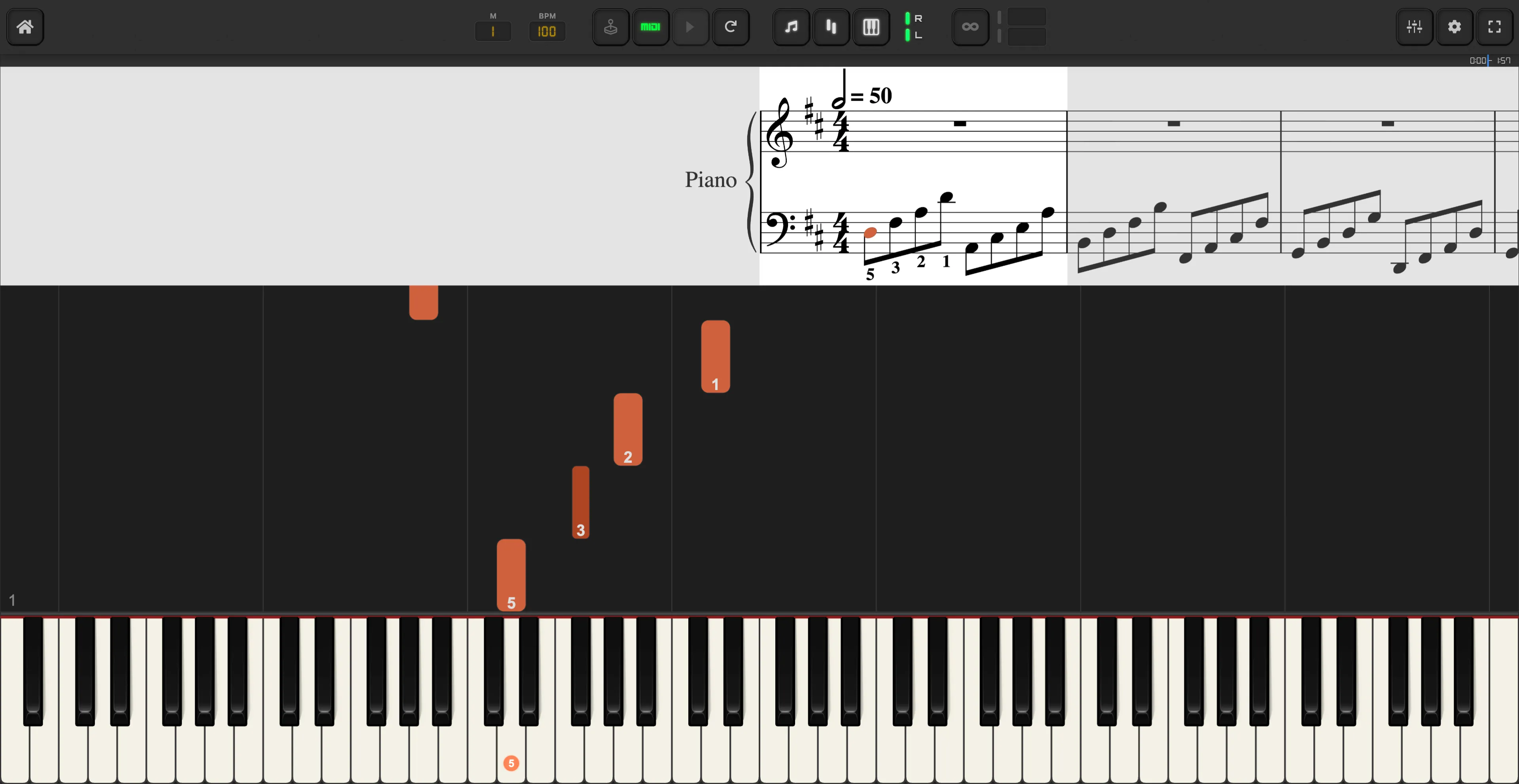
Showing notation and keyboard feedback together helps reduce the gap between what you read and what you play.
This creates a clear visual bridge between notation and keyboard while still letting you practice with real sheet music.
Instead of abandoning traditional notation, SunScore helps you understand it more quickly by making the connection between notes and keys immediately visible.
From Decoding Notes to Recognizing Patterns
Once the connection between notes and keys becomes stronger, reading music becomes much more natural.
Instead of slowly decoding every note, your brain begins to recognize familiar shapes and patterns on the staff. This is the moment when reading piano sheet music starts to feel intuitive.
With enough practice, what once looked like a confusing page of symbols becomes something you can read almost automatically.
Conclusion
Learning how to read piano sheet music faster becomes much easier when you address the two main challenges beginners face:
- processing too much information at once
- connecting notes on the page with keys on the piano
By simplifying practice and strengthening this note-to-key connection, the process of reading music becomes much more intuitive.
With time and practice, what once felt overwhelming becomes a natural part of playing the piano.